
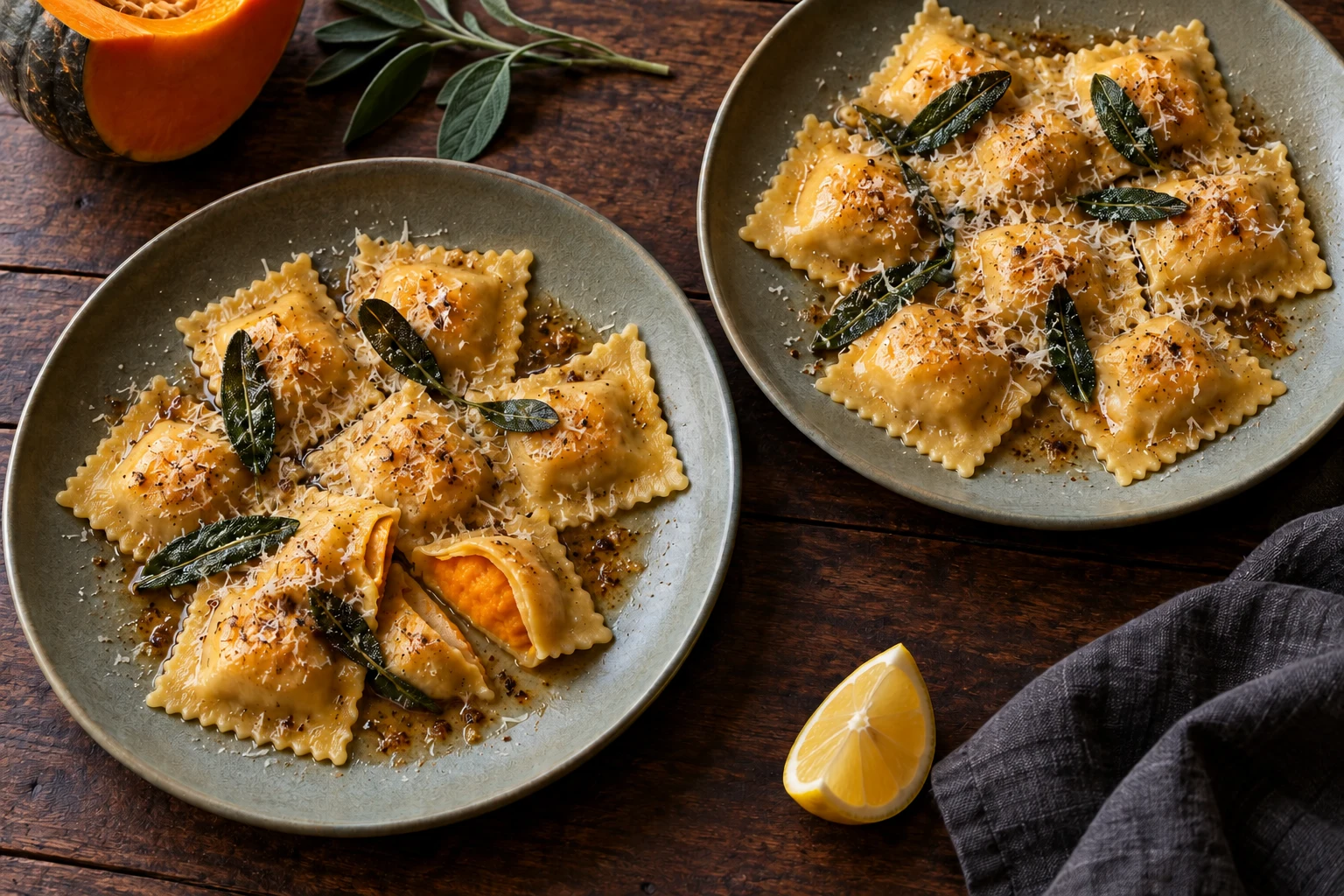
Homemade pumpkin ravioli are a rewarding project for an unhurried autumn afternoon. Thin egg pasta wraps a creamy filling of roasted squash and ricotta, then gets a glossy coat of brown sage butter. A little lemon brightens the naturally sweet squash. This batch serves four as a main course, with about eight ravioli each, plus practical instructions for keeping the filling firm and sealing the edges neatly.
Why brown sage butter works with pumpkin ravioli
Browning butter develops a toasted, nutty aroma that complements roasted squash. Sage adds a savory herbal note, while lemon juice brings acidity. A little starchy pasta water turns the butter into a light, glossy sauce that coats the pasta without hiding the filling. This is an Italian-inspired pumpkin-and-ricotta variation, made from scratch with a simple egg dough.
Useful tools for this recipe
Advertisement: The following links are affiliate links. We may earn a commission at no extra cost to you.
At a glance
Homemade Pumpkin Ravioli with Brown Butter, Sage and Lemon
- Prep time
- 1 hr 30 min
- Cook time
- 1 hr
- Total time
- 2 hr 45 min
- Yield
- about 32 ravioli
Total time includes 15 min of additional time. See the instructions for details.
Ingredients for 4 servings
Makes about 32 ravioli, approximately 7 × 7 cm (2 3/4 inches square), depending on dough thickness and trimming. Active preparation: about 90 minutes · Cooking, including roasting, reducing and pasta: about 60 minutes · Total with resting and cooling: about 2 hours 45 minutes, with some steps overlapping. Have a scale, lined baking sheet, pasta machine or long rolling pin, pastry wheel or knife, fork, fine grater, large pot, wide light-colored skillet and slotted spoon ready. Weights are the reference; household equivalents are approximate.
Ingredient links marked * are affiliate links. We may earn a commission at no extra cost to you.
| Amount | Ingredient |
|---|---|
| 300 g | (10.6 oz; about 2 1/2 cups) tipo 00 wheat flour* for the dough, plus up to 20 g for rolling and dusting |
| 3 | large eggs, about 150 g without shells |
| 1 g | fine salt* for the dough |
| — | Water for sealing the edges, plus 1–2 teaspoons if needed to adjust a dry dough |
| 600 g | (1 lb 5 oz) butternut squash flesh, weighed after peeling and removing the seeds |
| 10 g | olive oil* (about 2 teaspoons) for roasting |
| 100 g | (3.5 oz) ricotta, weighed after draining |
| 60 g | (2.1 oz) finely grated aged hard cheese: 40 g for the filling and 20 g to serve (such as Parmesan; use a microbial-rennet cheese for a vegetarian variation) |
| 2 g | fine salt* for the filling, with a little more only if needed after tasting |
| 1 | small pinch freshly grated nutmeg*, about 0.2 g |
| About 1/4 teaspoon | freshly ground black pepper* (0.5 g), divided between filling and sauce; more to taste |
| 80 g | (2.8 oz; about 5 1/2 tablespoons) unsalted butter for the sauce |
| 12–16 | fresh sage leaves (about 4 g), washed and thoroughly dried |
| 1 | small unwaxed lemon: use 1 teaspoon finely grated zest (about 1 g) and 1 tablespoon juice (15 ml), with extra juice only if needed to finish |
| 4 | liters (about 4.2 US quarts) water and about 20 g salt* for cooking; reserve 100–150 ml (about 1/2 cup) pasta water for the sauce |
How to make the ravioli
- Heat the oven to 200°C / 400°F conventional, or 180°C / 355°F fan. Cut the squash flesh into roughly 2 cm (3/4-inch) cubes, toss with 10 g olive oil and spread on the baking sheet. Roast for about 30–40 minutes, until tender with a few golden edges. Avoid heavily blackening the pieces.
- Meanwhile, bring the 300 g flour, eggs and 1 g fine salt together into a dough. Knead firmly for 8–10 minutes until smooth and elastic. It should be firm but workable. Only if it remains crumbly after kneading, add a little water a teaspoon at a time; if very sticky, use a minimal dusting of flour. Wrap airtight and rest for at least 30 minutes. Do not taste raw egg pasta dough.
- Mash or puree all the roasted squash, including the oil clinging to it. If wet, stir it in a dry skillet over medium heat until thick enough to hold on a spoon without forming a puddle. Aim for roughly 350 g concentrated puree from the entire starting quantity; do not drain away any squash liquid. Spread out and cool completely. Drain the ricotta in a fine strainer, then weigh 100 g.
- Mix the cold squash puree with the ricotta, 40 g hard cheese, 2 g fine salt, nutmeg, about half the black pepper and the lemon zest. Taste this egg-free filling and adjust cautiously with a little salt and pepper if needed, remembering that the cheese already contributes salt. The mixture should hold its shape on a spoon. Cover and refrigerate until needed.
- Divide the dough into four pieces and keep the unused pieces covered. Roll one piece at a time progressively through a pasta machine, or with a rolling pin, to about 1 mm thick. Dust sparingly. Place small mounds of about 15 g filling at roughly 7 cm (2 3/4-inch) intervals on a sheet, keeping about 1 cm of clear dough around the filling. Roll only as much dough as you can fill promptly.
- Lightly moisten the sealing edges with water only if needed. Cover with another sheet, or fold over a suitably wide sheet. Press outward from each mound to remove trapped air, then seal firmly. Cut into approximately 7 cm squares and, if helpful, gently press the edges with a fork without piercing the pasta. Set on a lightly floured board. Cover scraps, let them relax briefly and reroll them preferably only once. Aim for about 32 ravioli; the exact count can vary.
- Bring 4 liters of water with about 20 g salt to a boil, then reduce to a gentle simmer. Cook the ravioli in two or three batches for about 4–6 minutes. The filling should be hot and the pasta edges should no longer have a raw, floury core; carefully taste one to check. Timing depends on thickness, and floating alone is not a reliable doneness test. Reserve 100–150 ml cooking water before lifting out the ravioli.
- Meanwhile, melt the butter in the wide light-colored skillet over medium heat. Add the dry sage leaves and cook, swirling frequently, until the butter is golden and the milk solids are light brown with a nutty aroma, usually about 3–5 minutes. Remove the skillet from the heat as soon as it is ready. Very dark or black butter will taste bitter. Lift out crisp sage leaves temporarily if needed and reserve for serving.
- Let the pan cool slightly, then carefully add an initial 60 ml of hot pasta water; it can splutter. Add the 15 ml lemon juice and swirl over low heat until the sauce lightly emulsifies. Transfer cooked ravioli straight into it with a slotted spoon and coat gently. Add more reserved water a tablespoon at a time if needed for a glossy coating. When cooking several batches, hold the first briefly in the sauce without further simmering or piling up the ravioli.
- Taste a small spoonful of sauce. Finish with the remaining black pepper, a little extra salt only if needed and more lemon juice to taste. The cooking water and cheese already supply salt. Divide all the pasta among four warm plates and serve with the sage leaves and remaining 20 g hard cheese, approximately eight ravioli per main-course portion.
Keep the filling inside the pasta
Moisture is the main thing to control. Roasting and, if necessary, reducing the puree concentrate it, while ricotta is drained before weighing. Fill the pasta only once the mixture is completely cold. Clean, lightly dampened edges and pressing out trapped air help create a secure seal. Overfilling makes the parcels harder to close.
Pasta machine or rolling pin?
Either works. A rolling pin takes more time and effort to make an evenly thin sheet. If the dough resists or springs back, cover it and let it relax for another 10 minutes. Thick edges need longer to cook, so cut open a test raviolo rather than relying only on the timer.
Watch the brown butter closely
A light-colored skillet makes the milk solids easier to see. Remove the pan from the heat when they turn light brown, because residual heat keeps them cooking. Let the butter cool slightly before introducing lemon juice and pasta water. Add extra acidity in small increments, tasting as you go.
Make ahead and freeze
Prepare the roasted puree and filling a day ahead, cool promptly, cover and refrigerate. For longer preparation, freeze freshly shaped ravioli separately on a lightly floured freezer-safe tray, then transfer to a sealed container. Use within about two months. Cook directly from frozen at a gentle simmer, allowing extra time and checking both the pasta edges and the hot center. Cook or freeze fresh uncooked ravioli the day they are shaped to prevent them becoming soggy.
Choosing the squash and cheese
Butternut is easy to peel and puree smoothly. Another flavorful cooking pumpkin with firm flesh can work, though its water content changes how long you need to reduce it. The filling should be equally firm before shaping. Large decorative carving pumpkins are a poor choice for this filling. For a vegetarian variation, choose aged hard cheese made with microbial rennet; traditional Parmesan uses animal rennet.
Estimated nutrition per serving
Per one-quarter of the complete batch, roughly eight ravioli with sage butter and cheese: approximately 671 calories, 77 g carbohydrate, 24 g protein and 31 g fat. Includes the roasting oil, butter sauce, all 60 g hard cheese and up to 20 g dusting flour. Unused dough, flour left on the worktop and different ingredients change the estimate; divide the entire batch into four portions rather than relying on an exact ravioli count.
Contains wheat/gluten, eggs and milk. Keep the filling refrigerated until needed and do not taste raw egg pasta dough. Check cheese rennet type for dietary preferences and ingredient labels for allergies.
Recipe by myai
Made this recipe? Share your experience
No reviews yet. Have you tried this recipe?
Leave a Reply