
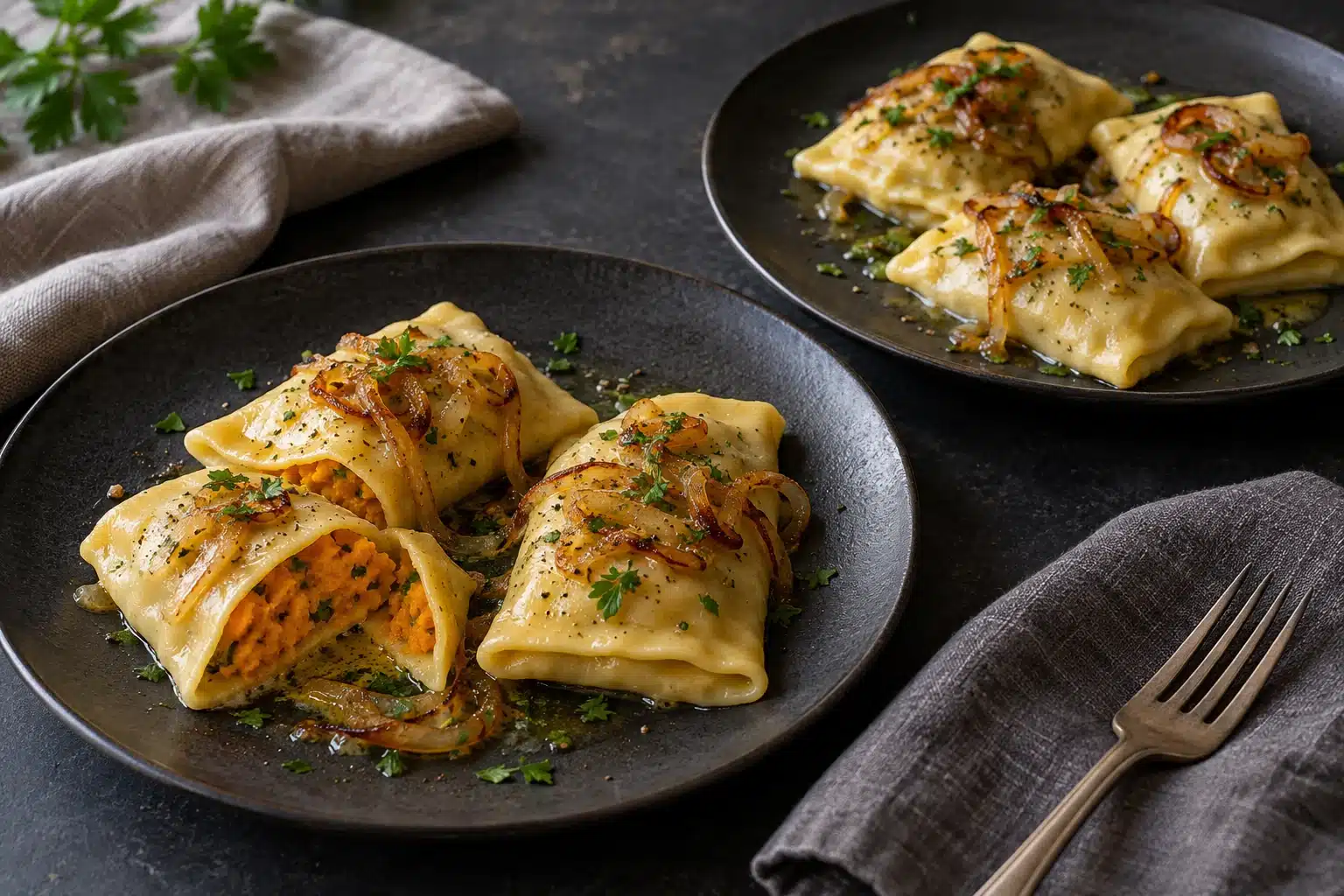
These pumpkin Maultaschen wrap roasted squash, savory alpine cheese and parsley in homemade egg pasta. Golden onions cooked gently in butter finish the plate. The filling contains no raw egg, so you can taste and season it before folding the parcels. Choose cheese made with microbial rennet for the vegetarian version.
A fall filling for Swabian pasta parcels
Maultaschen belong to Swabian cooking and may be folded or rolled, depending on the recipe. This autumn version uses roasted squash as its main filling ingredient. Roasting removes moisture, fine breadcrumbs bind the mixture, and cheese and nutmeg balance the squash’s sweetness.
Useful tools for this recipe
Advertisement: The following links are affiliate links. We may earn a commission at no extra cost to you.
At a glance
Homemade Pumpkin Maultaschen with Melty Cheese and Golden Onions
- Prep time
- 1 hr 15 min
- Cook time
- 1 hr 15 min
- Total time
- 2 hr 30 min
- Yield
- 12 Maultaschen
Ingredients for 12 large Maultaschen
Makes 4 main-course servings, 3 Maultaschen each. Allow about 75 minutes active preparation and about 75 minutes combined cooking, with resting and cooling partly overlapping: approximately 2 hours 30 minutes total. Vegetable weights are after peeling and trimming. You will need a rolling pin or pasta machine, a baking sheet, a large skillet, a wide pot and a slotted spoon. Gram weights are the recipe reference.
Ingredient links marked * are affiliate links. We may earn a commission at no extra cost to you.
| Amount | Ingredient |
|---|---|
| 300 g | tipo 00 wheat flour* for the dough, plus up to about 20 g for rolling |
| 3 | large eggs (about 150 g without shells) |
| 20 g | olive oil*, divided into 5 g for the dough, 10 g for the squash and 5 g for the filling onion |
| 2 g | fine salt* for the dough |
| 10–20 ml | water for the dough, only if needed, plus a little for sealing |
| 600 g | butternut squash flesh, peeled and seeded |
| 350 g | onions, peeled, divided into 100 g for the filling and 250 g for serving |
| 1 | garlic clove (about 5 g), peeled |
| 80 g | finely grated alpine-style hard cheese made with microbial rennet |
| 35 g | fine plain dry breadcrumbs*; finely crush coarse panko before weighing |
| 12 g | fresh flat-leaf parsley, divided into 8 g for the filling and 4 g for serving |
| 0.2 g | freshly grated nutmeg* (1 small pinch) |
| 0.5 g | freshly ground black pepper*, divided into 0.3 g for the filling and 0.2 g for the onions |
| 1 g | salt* to start the filling, then more to taste, plus a small pinch for the onions |
| 50 g | unsalted butter for the onions |
| 3 | liters water and 15 g salt* for poaching |
How to make pumpkin Maultaschen
- Roast the squash: Heat the oven to 400°F (200°C conventional) or 355°F (180°C fan). Cut the squash into roughly 3/4-inch (2 cm) cubes, toss with 10 g olive oil and spread on the baking sheet. Roast for about 30–40 minutes until tender, with dry, lightly browned edges. Use all the squash in the filling.
- Knead the dough: Meanwhile, combine the 300 g flour, eggs, 5 g olive oil and 2 g salt into a firm dough. Knead for 8–10 minutes until smooth and elastic. Only if crumbly and unable to come together, add water a teaspoon at a time. Cover and rest at room temperature for at least 30 minutes. Do not taste raw dough.
- Cook the filling onion: Finely dice 100 g onion and mince the garlic. Heat 5 g olive oil and cook the onion over medium heat for about 5 minutes until translucent, then add the garlic for another 30 seconds. Finely chop the parsley and divide into 8 g and 4 g.
- Bind and season the filling: Mash the cooked squash finely with a fork. If visibly wet, stir briefly in a dry skillet to evaporate excess moisture. Mix in the onion and garlic, grated cheese, breadcrumbs, 8 g parsley, nutmeg and 0.3 g black pepper. Let stand for about 10 minutes so the crumbs absorb moisture. Start with 1 g salt, then taste a small spoonful before adding more because the cheese already supplies salt. The filling should be savory and hold a mound. Let cool completely.
- Make the buttered onions: Thinly slice the remaining 250 g onions. Melt the butter in the large skillet. Cook the onions gently over low to medium heat for 20–25 minutes, stirring often, until golden brown. Do not scorch them. Season with a small pinch of salt and the remaining 0.2 g black pepper. If needed, add 1–2 tablespoons water to loosen the browned juices. Keep warm.
- Roll the pasta: Divide the dough in half. Roll each half on a little of the extra flour into a sheet about 48 x 24 cm (19 x 9 1/2 inches), approximately 1–1.5 mm thick, keeping the thickness even. Cover the unused half. Place each sheet with its long edges running horizontally and imagine three lengthwise bands, each about 8 cm wide.
- Fold twelve Maultaschen: Divide all the filling into 12 equal portions. On the middle lengthwise band of each sheet, place six compact mounds with their centers approximately 4, 12, 20, 28, 36 and 44 cm along the sheet. Leave clear dough between the mounds and at the ends. Lightly dampen those clear areas and the overlap with water. Fold the front third over the filling, then fold the back third over it. Gently press out trapped air. Press the ends and spaces between mounds firmly with the narrow side of a wooden-spoon handle, without tearing the dough. Cut through the middle of each pressed gap to make six closed parcels per sheet. Firmly pinch all cut edges again.
- Poach gently: Bring 3 liters water and 15 g salt to a boil in a wide pot, then reduce the heat. Poach the Maultaschen in two batches for about 15–18 minutes each in barely simmering water, without a rolling boil. Cut one open to check: the pasta should be tender with no raw, floury center, including the folded edges. Cook a few minutes longer if needed. Lift out with a slotted spoon and drain well.
- Serve: Taste the buttered onions again and adjust salt and pepper sparingly if needed. Divide the Maultaschen between four warm plates. Spoon all the onions and butter over them, scatter with the remaining 4 g parsley and serve three large parcels per person.
Use a dry, completely cooled filling
Wet squash makes sealing difficult and can soften the pasta. Roast the cubes uncovered, and briefly cook off visible moisture from the mash. Give the breadcrumbs time to hydrate. A cool filling that holds its shape is easier to portion than warm purée.
Keeping the parcels sealed
Use flour sparingly and brush loose flour off the sealing areas. Apply only a thin film of water, press out air and firmly flatten the gaps before cutting. Keep the poaching water at a gentle simmer. Thickness affects cooking time, so check the folded edges as well as the center.
Choosing the cheese
A savory alpine-style hard cheese balances mild squash. For vegetarian Maultaschen, choose a cheese labeled as made with microbial or vegetarian rennet. Other flavorful firm cheeses can work, but their saltiness varies; taste the filling before adding extra salt.
Make-ahead and reheating
Cool cooked parcels promptly in shallow containers and refrigerate within two hours. Store at 40°F (4°C) or below and eat within 2 days. Reheat gently with a little water under a lid until thoroughly hot, at least 165°F (74°C) in the center. Store onions separately and reheat thoroughly too. For freezing, freeze cooled cooked parcels individually before packing together; keep for up to 2 months, thaw in the refrigerator and reheat fully.
Estimated nutrition
Per serving of 3 out of 12 Maultaschen, including all the buttered onions: approximately 682 calories, 25 g protein, 91 g carbohydrate and 26 g fat. Includes all 600 g raw edible squash, the cheese and up to 20 g dusting flour. Brands, unused flour and portions change the estimate. No precise sodium is calculated because cooking-water salt uptake and final seasoning vary. Representative European product labels and food-composition data are used; this is not a US Nutrition Facts label.
Contains wheat/gluten, eggs and milk. Breadcrumbs and spices may contain other allergens or cross-contact; check packages. Taste only the cooked squash filling, never the raw egg pasta dough.
Recipe by myai
Made this recipe? Share your experience
No reviews yet. Have you tried this recipe?
Leave a Reply