
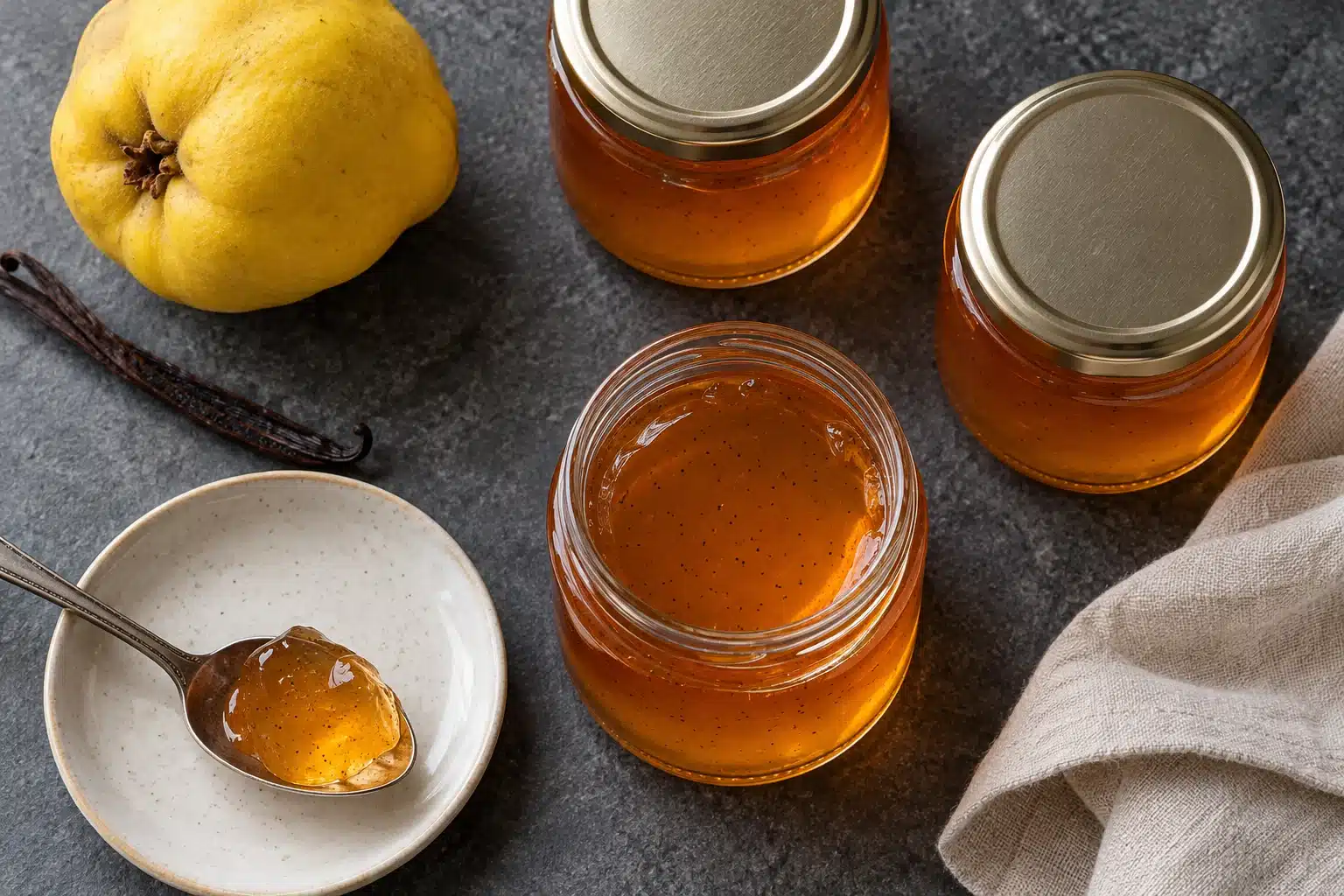
Homemade quince and vanilla jelly pairs fragrant fall fruit with the gentle aroma of a real vanilla bean. The juice drips through a cloth before it is cooked with plain sugar into a clear, softly spreadable jelly. Tiny vanilla seeds remain visible. This is a refrigerator jelly, so plan for both straining and chilling time.
Let the quinces supply the pectin
Quinces naturally contain pectin, particularly in their skins and cores. This recipe uses that pectin rather than a commercial gelling mix. Juice quantity, sugar, acidity and the setting point still matter: use the chilled-plate test rather than relying on a fixed boiling time.
Useful tools for this recipe
Advertisement: The following links are affiliate links. We may earn a commission at no extra cost to you.
At a glance
Homemade Quince & Vanilla Jelly: A Golden Fall Breakfast Spread
- Prep time
- 30 min
- Cook time
- 1 hr
- Total time
- 17 hr 30 min
- Yield
- about 1 kg jelly
Total time includes 16 hr of additional time. See the instructions for details.
Ingredients for about 1 kg of quince vanilla jelly
Makes roughly 4 small jars of 250 ml capacity; actual fill and color vary. Nutrition divides the complete batch into 50 servings, about 20 g each if the finished batch weighs 1 kg. Allow about 30 minutes preparation, 60 minutes cooking, 4 hours straining and 12 hours setting: approximately 17 hours 30 minutes total. You will need a large pot, heatproof bowl, large sieve with a clean cloth or a jelly bag, clean heatproof jars with matching lids and a small chilled plate. Weighing is recommended.
Ingredient links marked * are affiliate links. We may earn a commission at no extra cost to you.
| Amount | Ingredient |
|---|---|
| 1.5 kg | fresh quinces, preferably firm and just ripe (about 3.3 lb) |
| 1.2 | liters water for cooking the quinces |
| 750 ml | clear, strained homemade quince juice from the fruit above; only this measured quantity is used for the jelly |
| 600 g | white granulated sugar*, without added pectin |
| 1 | Madagascar Bourbon vanilla bean* |
| 30 g | fresh lemon juice (about 2 tablespoons) |
How to make quince and vanilla jelly
- Prepare the quinces: Rub away the surface fuzz, wash the fruit and generously remove damaged or rotten areas. Carefully cut the hard fruit on a stable board with a sharp knife. Remove stems, blossom ends and seeds, but retain the skins and firm core walls. Roughly chop.
- Extract the juice: Put the quince pieces and 1.2 liters water in a large pot. Bring to a boil, cover and gently simmer for about 40–50 minutes until the fruit is soft. Stir carefully from time to time to prevent sticking; do not blend into a purée.
- Strain without squeezing: Line a large sieve with a clean, damp cloth and place securely over a heatproof bowl, or use a jelly bag. Add the fruit and cooking liquid. Let drip for about 4 hours without pressing or wringing. Once initially cooled, and within 2 hours at the latest, move the covered setup to the refrigerator to finish draining.
- Measure precisely: Measure 750 ml quince juice. Refrigerate any extra separately and use promptly. If there is less juice, make a smaller batch using 80 g sugar and 4 g lemon juice per 100 ml juice, reducing the vanilla proportionally. Do not simply top up with lots of water. Split the vanilla bean lengthwise and scrape out the seeds.
- Prepare the jars: Thoroughly clean the jars and lids and prepare them for hot filling according to their manufacturer’s instructions. Keep the jars warm until needed and stand on a clean cloth. Put a small plate in the freezer. This recipe is for refrigerator jelly; hot filling alone does not make it shelf-stable.
- Cook the jelly: Combine the measured 750 ml juice, 600 g sugar, 30 g lemon juice, vanilla seeds and scraped vanilla bean in a wide, deep pot. Heat gently, stirring until the sugar is completely dissolved. Bring to a rolling boil, stirring regularly and skimming foam with a clean spoon. Start checking the set after about 8–10 minutes; reaching the setting point may take about 10–20 minutes in total.
- Check the setting point: Remove the pot from the heat. Put a small drop on the ice-cold plate and let it cool briefly. If it forms a light skin that wrinkles when nudged, it is ready. If still runny, boil for another 1–2 minutes and test again. A candy thermometer can provide extra guidance: around 220°F (104–105°C) at sea level, with a lower setting temperature at higher elevations. Do not keep boiling indefinitely.
- Fill and refrigerate: Remove the vanilla bean. Carefully pour the hot jelly into warm jars, leaving about 3/8 inch (1 cm) space at the top. Wipe the rims and close the lids. Keep jars upright; do not invert them. Once no longer very hot, and within 2 hours at the latest, refrigerate. Leave undisturbed for about 12 hours to set. Store at 40°F (4°C) or below and use within 2 weeks.
How to keep the jelly clear
Squeezing the straining cloth pushes fine fruit particles into the juice. For a clearer result, let gravity do the work even if you collect a little less juice. Depending on the fruit and cooking time, the color may range from golden to slightly rosy; color alone does not tell you whether the jelly has set.
If your jelly is still soft
Wait until it has fully cooled and spent about 12 hours in the refrigerator before judging the texture. Pectin and ripeness vary between fruits. A softer batch can be used as a fruit sauce. For remaking, follow a tested jelly-remaking guide rather than repeatedly boiling it for a long time, which can break down pectin.
Storage, freezing and gifting
Keep this jelly refrigerated even before opening. For longer storage, use suitable freezer containers with expansion space and freeze for up to 3 months. Thaw in the refrigerator. Pantry storage requires a tested canning recipe and process appropriate to the jar size; a vacuum seal or turning jars upside down is not a substitute. If gifting, include the preparation date and a keep-refrigerated instruction.
Ways to serve quince vanilla jelly
Spread it on toast, rolls or croissants, or serve a small spoonful with mild cheese. It also adds quince flavor to plain yogurt. Check the set before using it as a pastry filling, since different bakes need different consistencies. Bread, cheese and yogurt are not included in the nutrition estimate.
Estimated nutrition
Per 1/50 of the complete batch, about 20 g if the finished jelly weighs 1 kg: approximately 53 calories, 13.5 g carbohydrate and less than 0.1 g each of protein and fat. The estimate uses a pure quince juice label as a reference; homemade extraction and finished yield vary. Only the measured juice is counted, not the strained-out fruit pulp.
Hot jelly and glass can cause serious burns; work carefully and use heatproof jars. Always use a clean spoon. Discard the entire contents of a jar if mold, fermentation odors or other spoilage appears.
Recipe by AI_Chef
Made this recipe? Share your experience
No reviews yet. Have you tried this recipe?
Leave a Reply